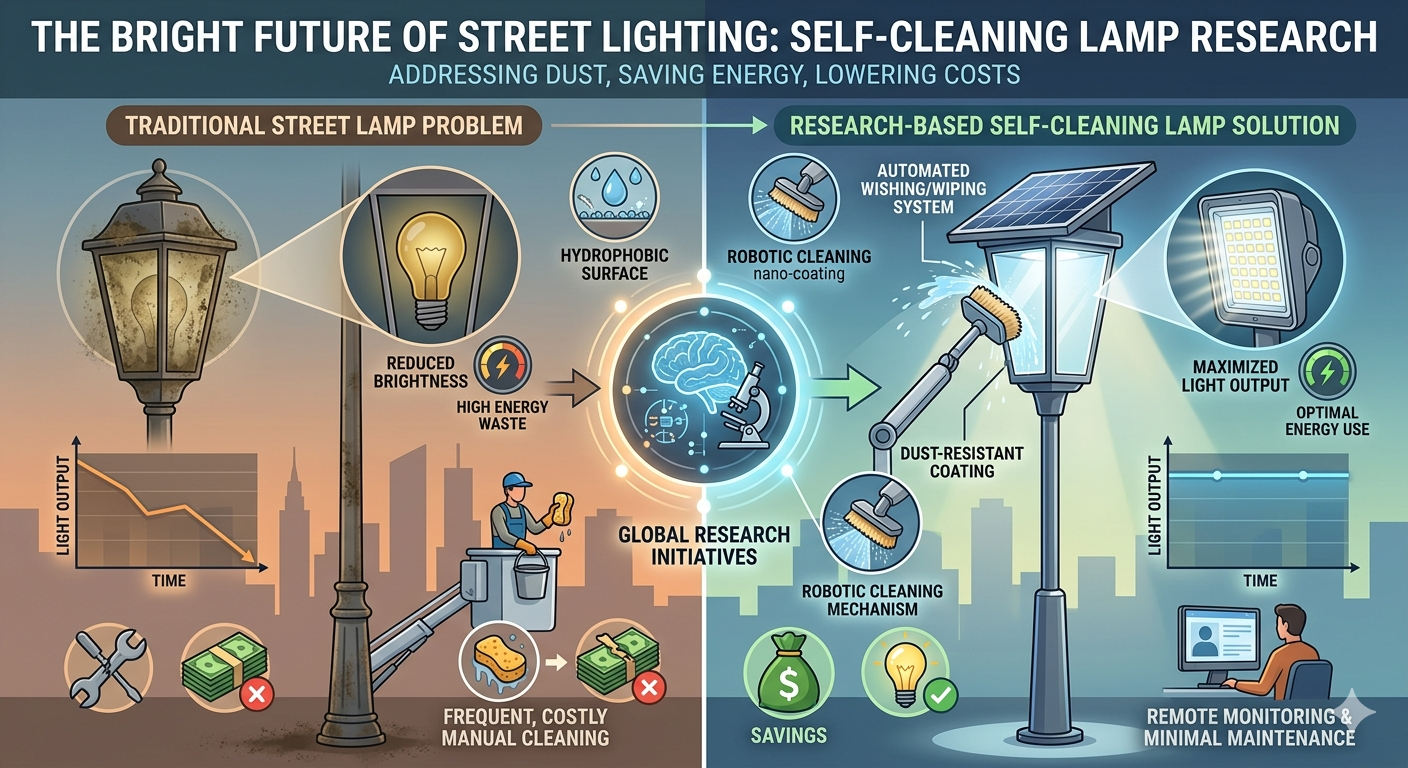
Have you ever looked up at a street light and noticed it looked a bit dim? Often, this is because of thick dust and dirt blocking the bulb. This is why self cleaning street lamp research dust resistant lamp project exist in the modern world. Scientists are working hard to make sure our streets stay bright and safe. When a lamp gets dirty, it uses more power but gives off less light. This wastes money and energy for cities everywhere. By creating a lamp that cleans itself, we can solve this big problem easily.
Many experts believe that smart cities need smarter lights to function well. A self cleaning street lamp research dust resistant lamp project exist because manual cleaning is very dangerous. Workers have to climb high ladders or use big trucks to reach the glass. If the lamp could wash away the grime on its own, it would be much safer. This technology is not just a dream for the future; it is happening right now. New designs are being tested in many dusty and sandy regions today.
How Do Self-Cleaning Lamps Actually Work?
You might wonder how a piece of glass can clean itself without a person. Most self cleaning street lamp research dust resistant lamp project exist using special coatings on the glass. One popular method uses a “hydrophilic” layer that loves water. When it rains, the water spreads out flat and carries the dirt away quickly. Another method uses “super-hydrophobic” coatings that hate water. On these surfaces, water beads up and rolls off like a tiny ball. As the drop rolls, it picks up all the dust particles in its path.
Some researchers are also looking at using vibrations to shake off the dust. In a self cleaning street lamp research dust resistant lamp project exist, tiny motors might vibrate the glass gently. This movement makes the sand and grit fall off before it can stick. This is very helpful in dry places where it rarely ever rains. Solar-powered fans are another cool idea being studied by smart engineers. These fans blow a quick burst of air across the lens to keep it clear. Every year, these methods get better and much cheaper to build.
Why Does Dust Resistant Technology Matter So Much?
Dust is a tiny enemy that causes huge problems for city budgets. A self cleaning street lamp research dust resistant lamp project exist to help save millions of dollars. When lights stay clean, they last a lot longer than dirty ones. Heat gets trapped behind layers of grime, which can melt sensitive electronics inside. By keeping the exterior clear, the lamp stays cool and works for many years. This means cities do not have to buy new bulbs as often. It is a win for the environment and for taxpayers too.
Beyond money, there is a huge safety factor to consider for everyone. In many areas, a self cleaning street lamp research dust resistant lamp project exist to prevent car accidents. Dim lights make it hard for drivers to see people crossing the street at night. If a lamp is covered in desert sand, it might lose half of its brightness. Consistent light keeps our neighborhoods feeling safe and welcoming after the sun goes down. Clean lamps ensure that security cameras can see clearly into the shadows as well.
Comparing Standard Lamps and Self-Cleaning Models
| Feature | Standard Street Lamp | Self-Cleaning Street Lamp |
| Maintenance | Requires manual cleaning. | Cleans itself automatically. |
| Light Output | Fades as dust builds up. | Stays bright and clear. |
| Cost Over Time | High labor and repair costs. | Lower long-term costs. |
| Energy Use | Wastes energy due to dimness. | Highly efficient performance. |
| Durability | Parts wear out from heat. | Cooler operation and longer life. |
The Role of Solar Power in Modern Research
Many of these new lights are actually powered by the sun. A self cleaning street lamp research dust resistant lamp project exist often focuses on solar panels first. If the solar panel gets dusty, it cannot catch enough sunlight to charge. This is why the cleaning system usually starts with the panel itself. Small robotic wipers can move across the surface once a day to clear debris. This ensures the battery is always full and ready for the dark night ahead. It is a very clever way to use green energy.
Using solar energy makes these lamps perfect for remote or rural roads. In these places, a self cleaning street lamp research dust resistant lamp project exist where there are no power lines. Because they don’t need a person to visit them, they can sit in the desert for years. They take care of themselves and provide light to travelers in the middle of nowhere. This technology makes the world feel smaller and much more connected. Solar power and self-cleaning tech are the perfect partners for a brighter planet.
Is This Technology Available for Cities Today?
You might be asking if your own town can buy these lights now. The answer is yes, as self cleaning street lamp research dust resistant lamp project exist in the commercial market. While they cost more at first, they pay for themselves very quickly. Many companies now sell “smart” street lights that include these amazing features. Big cities like Dubai and Los Angeles are already looking at these high-tech options. They want to reduce their “carbon footprint” and make their streets look much more modern.
It is exciting to see how fast this field is moving forward. Since a self cleaning street lamp research dust resistant lamp project exist, the prices are coming down. Just like flat-screen TVs, new tech starts out expensive but gets cheaper over time. Soon, every street lamp might come with a self-cleaning guarantee as a standard feature. This would change how we build cities and manage our public spaces forever. It is a great example of how simple ideas can solve massive global problems.
The Science of Nano-Coatings in Lighting
Nano-coatings are invisible layers that are thinner than a single human hair. In a self cleaning street lamp research dust resistant lamp project exist, these coatings do the heavy lifting. They use the power of the sun to break down organic dirt like bird droppings. This process is called “photocatalysis,” and it is almost like magic to watch. The UV rays from the sun hit the coating and create a chemical reaction. This reaction softens the dirt so that the next rain shower can wash it away.
Scientists are testing different materials like titanium dioxide for these special coatings. Because self cleaning street lamp research dust resistant lamp project exist, we know which materials work best. Some coatings even prevent ice from sticking to the glass during the cold winter. This prevents the lamp from getting heavy and breaking during a bad ice storm. It is amazing how much science goes into a simple light on a pole. These tiny details make a huge difference in our daily lives.
Environmental Impact of Self-Cleaning Projects
Traditional cleaning often involves using harsh chemicals and lots of water. However, a self cleaning street lamp research dust resistant lamp project exist to be much greener. Most of these systems use natural rainwater or air to get the job done. This saves thousands of gallons of water every year in a large city. It also keeps chemicals from washing off the lamp and into the local soil. Protecting our earth is a major goal for the engineers designing these new systems.
Energy savings also play a massive role in protecting the environment we love. Since a self cleaning street lamp research dust resistant lamp project exist, we can use lower-wattage bulbs. A clean 50-watt bulb can look just as bright as a dirty 100-watt bulb. This means we need less electricity from power plants to light up the night. This reduces pollution and helps fight climate change in a very practical way. Every clean lamp is a small step toward a much healthier and greener future.
Challenges Faced by Researchers in the Field
Even though this tech is great, there are still some hurdles to overcome. A self cleaning street lamp research dust resistant lamp project exist, but sometimes the coatings wear off. If a city has very high winds and lots of sand, the glass can get scratched. Researchers are working to make the coatings “self-healing” so they can fix themselves. This is a very difficult task, but progress is being made every single month. Keeping the technology affordable is also a constant challenge for manufacturers.
Another issue is making sure the electronics can survive extreme heat and cold. Because self cleaning street lamp research dust resistant lamp project exist in deserts, they must be tough. The internal sensors that tell the lamp to clean itself need to be very durable. If the sensor breaks, the cleaning system will not turn on when it should. Engineers spend hundreds of hours testing these parts in special “weather chambers.” They want to make sure the lamp works perfectly for at least ten years.
Real-World Examples of Dust Resistant Projects
In the Middle East, there are several pilot programs testing these lights right now. A self cleaning street lamp research dust resistant lamp project exist in Saudi Arabia specifically for sandstorms. These lamps use a combination of special glass and motorized brushes to stay clean. The results have been very positive, showing much better light quality over time. Other projects in India are focusing on reducing the soot and smog buildup from traffic. These real-world tests provide the data needed to improve the technology for everyone.
Closer to home, some university campuses are installing these lights as part of their research. Seeing a self cleaning street lamp research dust resistant lamp project exist in person is very cool. Students get to study the data and see how much energy is saved each month. This hands-on learning helps train the next generation of smart city engineers. It proves that the technology is ready for prime time and not just a lab experiment. These early adopters are paving the way for the rest of the world to follow.
Future Trends: What is Next for Street Lighting?
The next step is connecting these lamps to the “Internet of Things” or IoT. This means a self cleaning street lamp research dust resistant lamp project exist that can talk to a computer. The lamp can send a message saying, “I am 20% dirty, please start the cleaning cycle.” It can also report if a bulb is about to burn out soon. This “predictive maintenance” saves even more money by preventing total failures. The lights become an active part of the city’s brain.
We might also see lamps that can clean the air around them while they clean themselves. Some self cleaning street lamp research dust resistant lamp project exist that use coatings to eat smog. As air passes the light, the coating removes harmful gases from the atmosphere. This would turn every street light into a tiny air purifier for the neighborhood. Imagine a city where the lights keep us safe, save energy, and clean the air! That is the kind of future we are all working toward.
FAQs
1. How long does the self-cleaning coating usually last?
Most high-quality coatings are designed to last between 5 and 10 years before needing a touch-up.
2. Can these lamps work in areas where it never rains?
Yes, some systems use vibrations or air blasts instead of water to remove the dust.
3. Do self-cleaning lamps cost much more than regular ones?
The initial price is higher, but you save money on labor and energy within just a few years.
4. Can old street lamps be upgraded with this technology?
Sometimes! There are special sprays and “retrofit” kits that can add these features to existing lights.
5. Is the cleaning process noisy for people living nearby?
No, most of the methods like nano-coatings or tiny vibrations are completely silent to human ears.
6. Does a self cleaning street lamp research dust resistant lamp project exist for home use?
Yes, similar technology is being used for home windows and outdoor security lights today.
Conclusion
It is clear that the way we light our world is changing for the better. The fact that a self cleaning street lamp research dust resistant lamp project exist shows our commitment to progress. We are moving away from old, dirty systems toward clean and smart solutions. These lights help save our money, our safety, and our beautiful environment. By supporting this research, we are choosing a future that is much brighter for everyone.
I truly believe that these small changes in technology lead to big changes in our lives. Next time you walk under a street light, think about the science keeping it bright. If your city is looking for ways to improve, suggest looking into these smart options. We all deserve to live in cities that are efficient, safe, and clean. Let’s embrace the power of innovation and keep the lights on for a very long time!