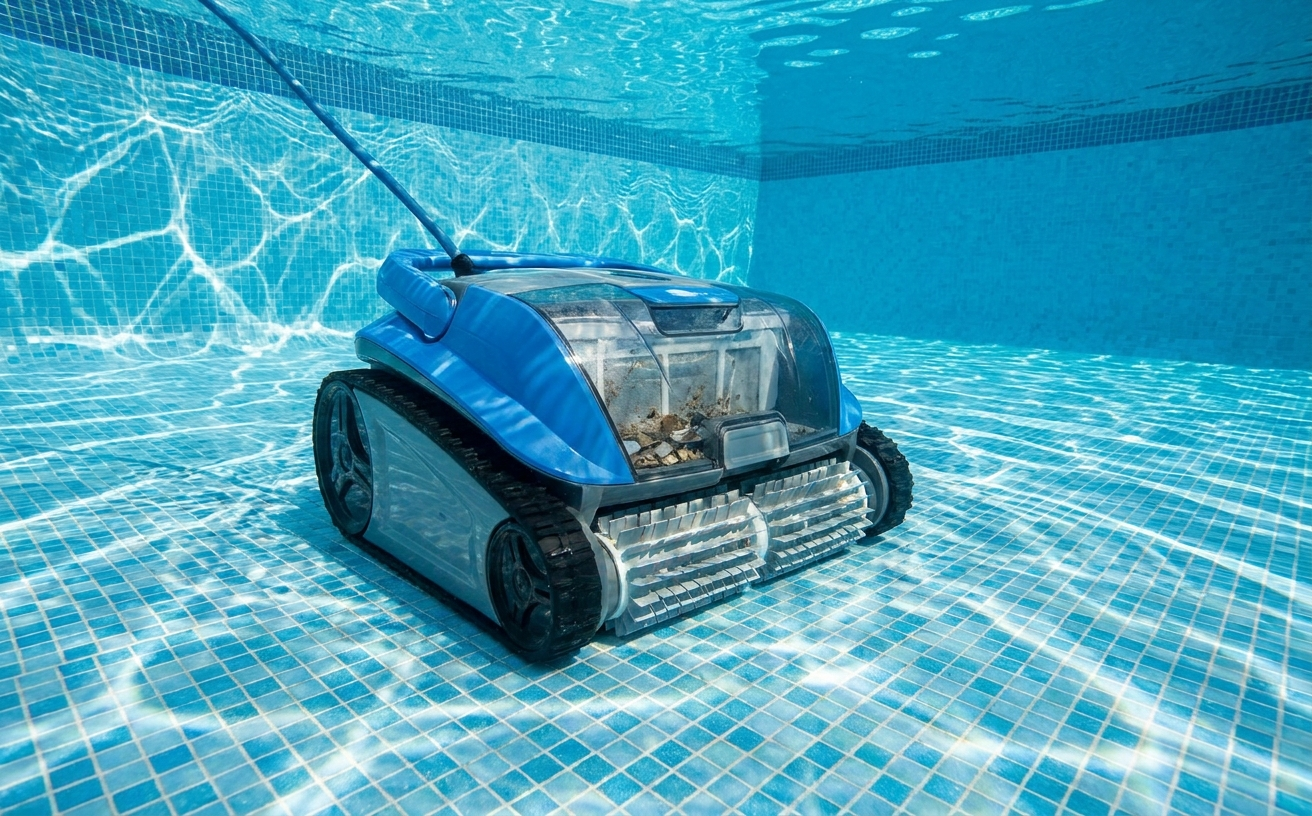
Focus on the features that matter most: strong suction, reliable navigation, wall cleaning, easy maintenance, and a filter system that handles real pool debris.
Keeping a swimming pool clean can be time‑consuming, especially during peak season.
Robotic pool cleaners have become a popular solution because they automate the cleaning process. However, not all models deliver the same results.
After extensive testing of dozens of units, certain features consistently separate effective cleaners from those that fall short.
Understanding these key features helps buyers make an informed investment.
Corded vs. Cordless: Key Considerations
The first major decision is whether to choose a corded or cordless model.
Corded cleaners plug into a standard outdoor GFCI outlet and draw continuous power.
They deliver steady suction throughout the cleaning cycle, with no drop‑off in performance.
Most corded units can run on a daily schedule, providing true set‑and‑forget convenience.
You simply set the weekly timer once, and the robot cleans each day without further attention.
Cordless cleaners, on the other hand, rely on lithium‑ion batteries.
Typical runtimes range from 60 to 120 minutes, followed by a recharge that takes several hours.
This means you cannot run multiple cycles back to back.
After the battery dies, the cleaner often sinks to the bottom, requiring you to fish it out with a pole.
In addition, the added weight of the battery makes handling more difficult.
There are also safety concerns.
Reports have surfaced of certain cordless pool cleaners overheating and causing fires. The U.S.
Consumer Product Safety Commission has issued recalls for thousands of units due to battery fire risks.
While not every cordless model poses the same danger, the reliability and peace of mind offered by corded cleaners are difficult to ignore.
For these reasons, most experts currently recommend corded units for consistent performance and safety.
Essential Filtration: Why Standard Mesh Isn’t Enough
The filter is arguably the most critical component of any robotic cleaner.
Many budget models use basic plastic mesh screens with large pores.
While these catch leaves and pebbles, fine dirt, algae spores, and bacteria pass right through.
As a result, the water may appear clear on the surface but remains cloudy and unhygienic.
Higher‑quality cleaners employ pleated filters, often called NanoFilters.
These tightly woven polyester filters capture microscopic particles down to a few microns in size.
In head‑to‑head tests, pleated filters trap much more debris than standard mesh.
The difference is visible: water stays cleaner longer, and you use fewer chemicals. When evaluating potential purchases, always check the filter type.
A cleaner with a pleated filter will provide a healthier pool and reduce the need for additional water treatment.
Full Pool Coverage: Floors, Walls, and Waterline
A robotic cleaner should scrub every surface of the pool, not just the floor.
The waterline is often the dirtiest area, where oils, sunscreen, and debris accumulate.
Many cheaper cleaners lack the ability to climb walls or clean the waterline effectively.
A good unit should have dual brushes and enough traction to ascend walls and scrub the waterline consistently.
Look for models that include waterline cleaning as a standard feature.
This ensures that the entire pool receives attention, preventing unsightly buildup and reducing the need for manual scrubbing.
True Automation with a Weekly Smart Timer
One of the main reasons to buy a robotic cleaner is to save time.
A weekly smart timer is the feature that delivers real automation.
With a simple press of a button, you can program the cleaner to run at the same time every day.
The robot turns itself on, cleans the pool, and then shuts off automatically.
You only need to empty the filter once a week.
Without a timer, you must manually walk to the pool each day to start the cycle. This quickly becomes a chore.
Many entry‑level models omit the timer to lower the price, but the convenience it provides is well worth the extra cost.
For a truly hands‑off experience, a weekly smart timer is essential.
Commercial‑Grade Motors for Longevity and Power
The motor is the heart of any robotic cleaner.
Units equipped with commercial‑grade motors deliver significantly more suction and cleaning power than those with residential motors.
These motors are the same ones used in machines that clean public pools and water parks.
They offer stronger wall‑climbing ability, better waterline grip, and a longer operational lifespan.
Owners of such models often report ten years or more of reliable use with minimal repairs.
When you invest in a cleaner with a commercial motor, you also benefit from readily available replacement parts. This extends the useful life of the machine and reduces long‑term costs. While the upfront price may be higher, the performance and durability justify the expense.
Making the Right Choice
Selecting the best pool cleaner requires careful evaluation of these key features: corded power, pleated filtration, full coverage, a weekly timer, and commercial‑grade motors.
Models that combine these characteristics consistently outperform those that cut corners.
Avoid the temptation of low‑cost cordless units that compromise on safety, filtration, and automation.
Instead, focus on a truly automated solution that runs reliably day after day.
When you choose a robotic pool cleaner with these proven features, you ensure consistent performance, cleaner water, and long‑term satisfaction.
The right cleaner will pay for itself in time saved and reduced chemical usage, letting you enjoy your pool rather than work on it.